Self-driving toy car
Turning a 1/16-scale DonkeyCar into an autonomous car — and a testbed for modern edge ML
An ongoing project: training self-driving policies in simulation and deploying them to a Jetson Nano (with a Coral Edge TPU planned). Overview, architecture, and a build log.
I’m turning a DonkeyCar — a 1/16-scale RC car — into a small autonomous vehicle. It’s a deliberately constrained playground for the parts of modern ML I find most interesting: reinforcement learning, sim-to-real transfer, vision-language-action models, and the unglamorous reality of making all of that run on cheap, power-limited edge hardware.
This page is the hub: what the car is, how it’s put together, and where the project is going. The build log below collects the individual posts on architecture and progress as I write them.
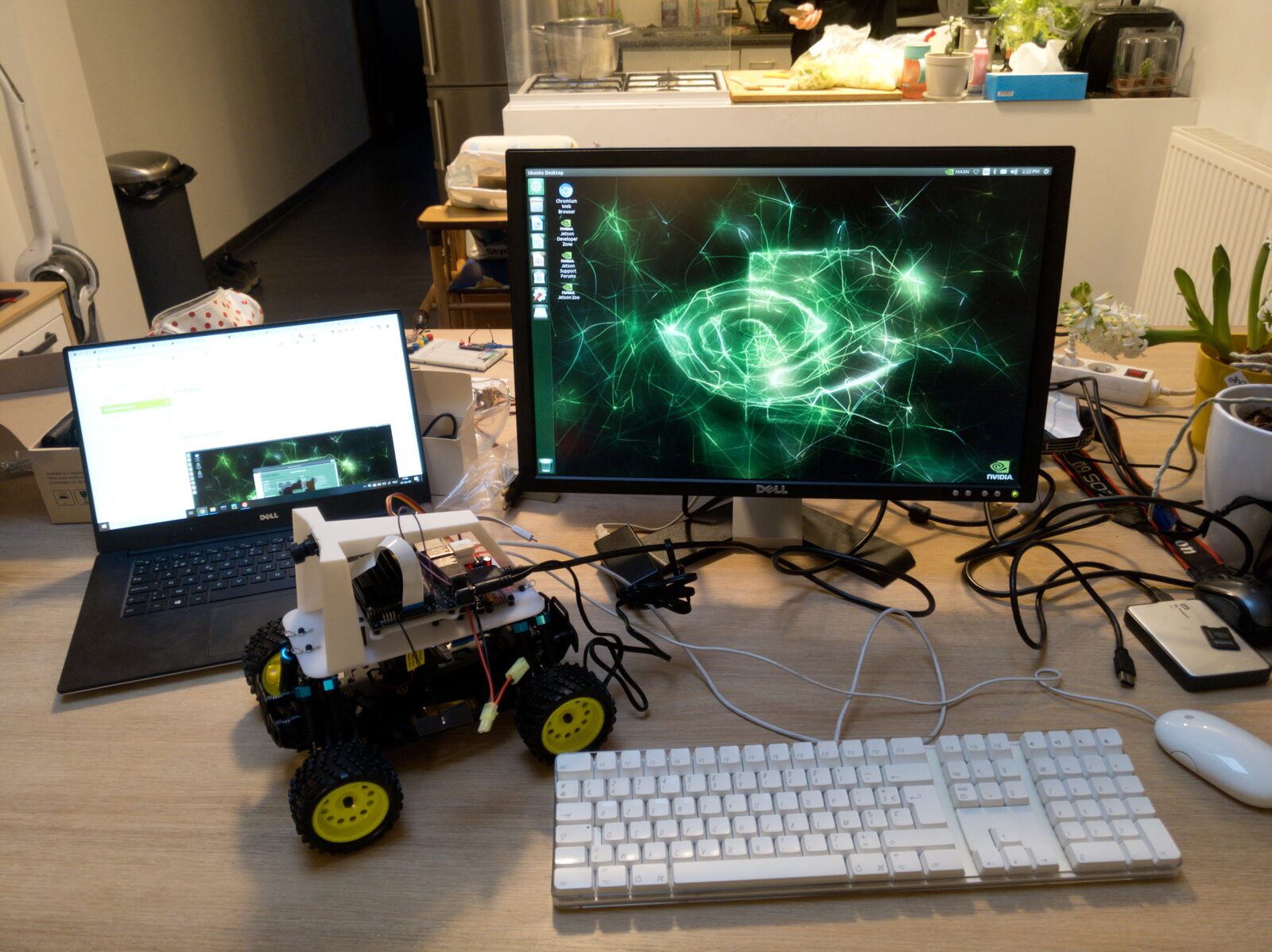
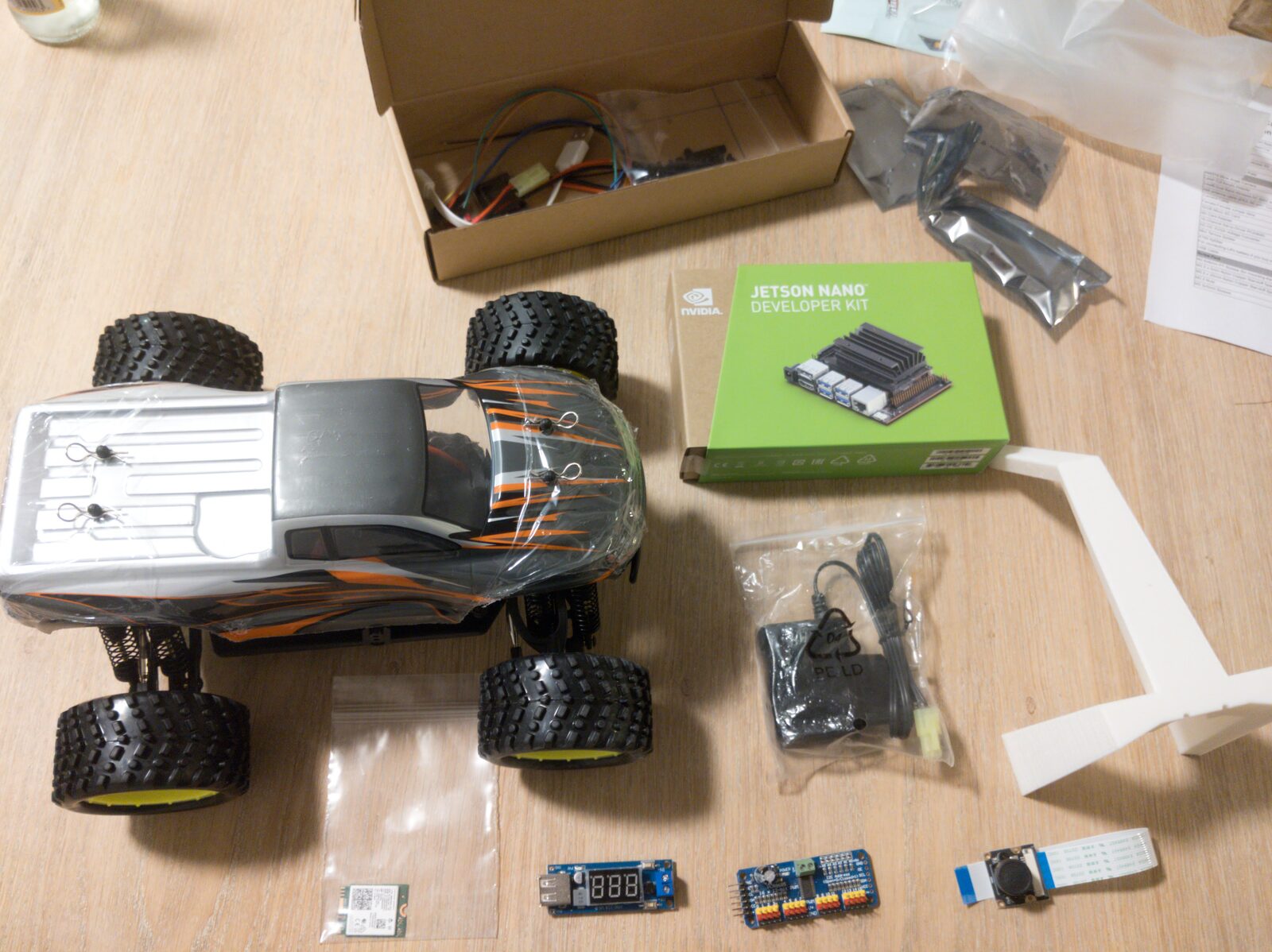
The hardware
| Part | Role |
|---|---|
| Jetson Nano (4 GB, B01) | On-board inference |
| RC car chassis + ESC + brushed motor | The vehicle |
| Wide-angle CSI camera (IMX219) | The only sensor the model gets |
| PCA9685 (16-channel PWM driver) | Steering servo + ESC control over I²C |
| TCBWORTH 1800 mAh LiPo | Drive battery (motor + servo rail) |
| RED-E 10 000 mAh power bank | Untethered power for the Nano |
A training PC (RTX 4070) sits on the same network for the heavy lifting later. A Coral Edge TPU is planned but not yet in the build — see the roadmap.
The architecture
One idea runs through the whole project: a slow brain and fast reflexes, split across devices. This is the intended design — today the car drives from the Nano alone over the web controller, and the pieces below get built out along the roadmap.
- System 1 — fast reflexes. A tiny convolutional policy that maps camera frames to steering and throttle, quantized to INT8 for the real-time control loop. The plan is to offload this to a Coral Edge TPU (a USB INT8 accelerator) so it runs at high frame rate and low power; for now it would run on the Nano.
- Host — the Nano. Camera capture, actuator control over I²C, and the safety/glue layer.
- System 2 — off-board. An optional, slower model (a small vision-language-action model, or an LLM planner) that issues high-level intent over wifi at a few hertz, which System 1 then carries out.
The guiding constraint is simple: train off-device, deploy on-device. The Nano’s software stack is too old for a modern training toolchain, so learning happens on a real GPU off-board and the car only ever runs a compiled artifact.
Roadmap
Roughly most-feasible to most-ambitious. Each step reuses the deployment pipeline built by the one before it, and each will get its own build-log post.
- Hardware audit & baseline — confirm what each device runs; get teleop and the Coral working end to end.
- Line following, classic CV — point the camera forward, threshold + centroid + a P-controller, and drive a loop with no ML. Gets the car physically moving and sets a baseline lap time.
- Line following, learned: BC-CNN → Coral — redo it as a small CNN, quantized to INT8 and compiled for the Coral. This commissions the train → quantize → compile → deploy pipeline, and — seeing ahead — should beat the CV lap time.
- LLM as an offline copilot — use a large model off-line to design reward functions, generate track curricula, and analyse failure logs.
- Sim RL with PufferLib — train a policy in
gym-donkeycarwith PPO (pure Python), then distil and deploy. - High-throughput RL in JAX — a fast custom driving env, GPU-vectorized, trained in minutes, transferred with domain randomization.
- Dual-system “talk to your car” — an off-board vision-language-action model issuing intent, the Coral handling control.
- Dream-to-drive — a JAX world model, training the policy in imagination.
Build log
Posts on architecture and progress, oldest first. (More to come — this fills in as the roadmap above gets built.)